car design, american car design, car design studio, auto car, automotive car design

Showing posts with label Koenigsegg. Show all posts

Sunday, March 28, 2010

2011 Koenigsegg Sports Car Agera - Celebrate 15 Years

Geneva Motor Show 2010 - The new Koenigsegg Agera. To celebrate 15 years of making dream cars, Koenigsegg unleash their latest jewel, the Koenigsegg Agera. A new supercar aimed to take the Koenigsegg experience to the next level, both on the road and the track. 
2011 Koenigsegg Agera
The Agera is on display at the 80th Salon International de l’Auto in Geneva. The Agera shares some styling tweaks that are similar to the CCX and owes its name to the Swedish translation of “to act”, thus symbolizing the Koenigsegg philosophy of always improving its cars and pushing its designs to the limit.
2011 Koenigsegg Agera
Koenigsegg Agera is powered by Twin Turbo engine with 910 hp in term of running on regular petrol. Coming on to the major details, based on the regular CC, the Koenigsegg Agera boasts of a 4.7-liter twin turbocharged V8 producing 910 PS (669 kW/898 hp) at 6850 rpm and 1100 Nm (811 lb-ft) at 5100 rpm. There is over 1000 nm of torque available from 2680 to 6100 rpm.
2011 Koenigsegg Agera
To balance this, the Agera features the latest in braking technology with 392×36 and 380×34 ventilated and drilled ceramic discs. When combined with a dry weight of just 2,832 lbs and the sequential gearbox the Agera can sprint to 100 km/h in as little as 3.1 seconds, 200 km/h (124 mph) in 8.9 seconds and blast on to a top speed of 245+ mph. As well, new traction control is fitted with auto adapt functionality for different road conditions and driving styles as well as several manual settings.
2011 Koenigsegg Agera
Koenigsegg’s designers have tried to push through some difference via the slightly modified front and rear bumpers. However the car’s carbon-Kevlar body, removable top that stores into the bonnet and aluminum honeycomb reinforced carbon fiber chassis, all keep it close to the outgoing CCX.
2011 Koenigsegg Agera
The distinguishable additions are the all-new carbon fibre center console and tunnel assembly and the new type of ambient lighting called “Ghost Lights” where illumination shines through the car’s billet aluminum buttons and surfaces by way of invisible nanotubes.
2011 Koenigsegg Agera
Beside the new engine performance, Koenigsegg also features the new Koenigsegg Agera stitching and seams for Agera interior and has developed a new type of interior illumination, which shines through the billet aluminum buttons and surfaces by way of invisible nanotubes.
2011 Koenigsegg Agera
The Koenigsegg Sports Car Agera will be produced in parallel to the Award winning CCX and CCXR models. The pre-production show car will be put through its phases for the coming six month prior to the production car launch of the Agera. Pricing details have not been revealed as of now but it is being said that the supercar maker will bring a pre-production model of the Agera to the Swiss Motor Show. According to GTSpirit, just 16-20 Agera models will be built each year, starting later this year.

2011 Koenigsegg Sports Car Agera - Celebrate 15 Years

Geneva Motor Show 2010 - The new Koenigsegg Agera. To celebrate 15 years of making dream cars, Koenigsegg unleash their latest jewel, the Koenigsegg Agera. A new supercar aimed to take the Koenigsegg experience to the next level, both on the road and the track. 
2011 Koenigsegg Agera
The Agera is on display at the 80th Salon International de l’Auto in Geneva. The Agera shares some styling tweaks that are similar to the CCX and owes its name to the Swedish translation of “to act”, thus symbolizing the Koenigsegg philosophy of always improving its cars and pushing its designs to the limit.
2011 Koenigsegg Agera
Koenigsegg Agera is powered by Twin Turbo engine with 910 hp in term of running on regular petrol. Coming on to the major details, based on the regular CC, the Koenigsegg Agera boasts of a 4.7-liter twin turbocharged V8 producing 910 PS (669 kW/898 hp) at 6850 rpm and 1100 Nm (811 lb-ft) at 5100 rpm. There is over 1000 nm of torque available from 2680 to 6100 rpm.
2011 Koenigsegg Agera
To balance this, the Agera features the latest in braking technology with 392×36 and 380×34 ventilated and drilled ceramic discs. When combined with a dry weight of just 2,832 lbs and the sequential gearbox the Agera can sprint to 100 km/h in as little as 3.1 seconds, 200 km/h (124 mph) in 8.9 seconds and blast on to a top speed of 245+ mph. As well, new traction control is fitted with auto adapt functionality for different road conditions and driving styles as well as several manual settings.
2011 Koenigsegg Agera
Koenigsegg’s designers have tried to push through some difference via the slightly modified front and rear bumpers. However the car’s carbon-Kevlar body, removable top that stores into the bonnet and aluminum honeycomb reinforced carbon fiber chassis, all keep it close to the outgoing CCX.
2011 Koenigsegg Agera
The distinguishable additions are the all-new carbon fibre center console and tunnel assembly and the new type of ambient lighting called “Ghost Lights” where illumination shines through the car’s billet aluminum buttons and surfaces by way of invisible nanotubes.
2011 Koenigsegg Agera
Beside the new engine performance, Koenigsegg also features the new Koenigsegg Agera stitching and seams for Agera interior and has developed a new type of interior illumination, which shines through the billet aluminum buttons and surfaces by way of invisible nanotubes.
2011 Koenigsegg Agera
The Koenigsegg Sports Car Agera will be produced in parallel to the Award winning CCX and CCXR models. The pre-production show car will be put through its phases for the coming six month prior to the production car launch of the Agera. Pricing details have not been revealed as of now but it is being said that the supercar maker will bring a pre-production model of the Agera to the Swiss Motor Show. According to GTSpirit, just 16-20 Agera models will be built each year, starting later this year.

Saturday, November 14, 2009

Supercar Koenigsegg Trevita


Koenigsegg Trevita is a accurate supercar jewel which represents new architecture heights in the auto world. The name Trevita comes from the Swedish accent and it agency – three whites. At aboriginal glance, the Trevita’s anatomy looks aforementioned as the CCXR’s, but with one big difference, the new Trevita is absolutely shaped in design white carbon application the new Koenigsegg Proprietary Design Weave technology.

With the new and different technology, Koenigsegg has managed to covering fibers with a design finish. The action was absolutely developed at Koenigsegg address in Angelholm Sweden, area the cilia analysis is conducted anxiously in baby quantities, above-mentioned to added processing the prepreg material.

And now the best absorbing part, Koenigsegg said that they will alone aftermath three Trevitas in total, appropriately the name, which automatically enthrones the supercar jewel as one of the best attenuate cars in the world.

Although there were no advice on the Trevita’s powertrain, we accept that it will accede the CCXR’s one. But for abiding the three cars will be able with Koenigsegg Shimmering Design Weave bodywork, bifold carbon wing, paddle-shift, inconell bankrupt system, carbon bowl brakes with ABS, hydraulic appropriation system, infotainment system, tyre ecology system, chrono apparatus array and airbags.

Saturday, October 3, 2009

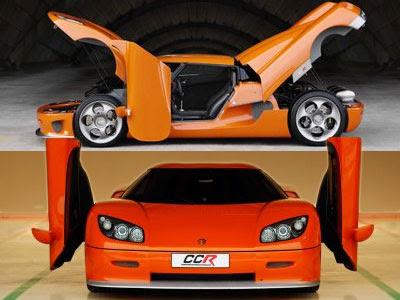
Koenigsegg CCR Design Sport Car Concept

Koenigsegg CCR Design Sport Car Concept

Koenigsegg's design seeks to give an interpretation of strength and flowing motion. The body of a Koenigsegg is formed for one ultimate purpose; speed. Its beauty is the beauty of speed itself. The surfaces are shaped to perfectly aerodynamic, an appearance that does not deceive. All aspects of this machine serve its one fundamental objective. Both the body and chassis of a Koenigsegg are made of extremely lightweight carbon fibre composite, reinforced with Kevlar and aluminium honeycomb. Its race-bred suspension system brings the driver in control of all movement, even under the toughest racing conditions.
The car was styled by Christian von Koenigsegg himself but its shape is largely dictated by aerodynamics. It is not as striking as Pagani or Enzo. At some angles it even looks bulky, like a big whale. But the whale delivers a sense of power that you can't find in its rivals either. Because of the targeted top speed, the body is designed to be so smooth that it has a very low drag coefficient of 0.30. This is much lower than Enzo (0.36), SLR (0.37) and Carrera GT (0.39). Unsurprisingly, the downside is a rather low downforce, just 50kg at the front and 70kg at the back. For comparison, an Enzo generates 775kg while Pagani achieves 500kg.
The chassis is constructed like other supercars. Central to it is a carbon-fiber tub (Koenigsegg called it "semi-monocoque") attached with steel subframe up front and aluminum subframe at the rear for mounting engine, gearbox and suspensions. Chassis rigidity is 28,100Nm per degree despite of the targa roof. The whole bodyshell is also carbon-fiber. Koenigsegg claims a dry weight of 1175kg, which translates to 1275kg when fluid and fuel are loaded, i.e., what we usually refer to "kerb weight". In other words, CC8S is about as light as Pagani and Saleen S7, while being around 100 kilograms lighter than Enzo and Carrera GT.

Koenigsegg CCR Design Sport Car Concept

Koenigsegg CCR Design Sport Car Concept

Koenigsegg's design seeks to give an interpretation of strength and flowing motion. The body of a Koenigsegg is formed for one ultimate purpose; speed. Its beauty is the beauty of speed itself. The surfaces are shaped to perfectly aerodynamic, an appearance that does not deceive. All aspects of this machine serve its one fundamental objective. Both the body and chassis of a Koenigsegg are made of extremely lightweight carbon fibre composite, reinforced with Kevlar and aluminium honeycomb. Its race-bred suspension system brings the driver in control of all movement, even under the toughest racing conditions.
The car was styled by Christian von Koenigsegg himself but its shape is largely dictated by aerodynamics. It is not as striking as Pagani or Enzo. At some angles it even looks bulky, like a big whale. But the whale delivers a sense of power that you can't find in its rivals either. Because of the targeted top speed, the body is designed to be so smooth that it has a very low drag coefficient of 0.30. This is much lower than Enzo (0.36), SLR (0.37) and Carrera GT (0.39). Unsurprisingly, the downside is a rather low downforce, just 50kg at the front and 70kg at the back. For comparison, an Enzo generates 775kg while Pagani achieves 500kg.
The chassis is constructed like other supercars. Central to it is a carbon-fiber tub (Koenigsegg called it "semi-monocoque") attached with steel subframe up front and aluminum subframe at the rear for mounting engine, gearbox and suspensions. Chassis rigidity is 28,100Nm per degree despite of the targa roof. The whole bodyshell is also carbon-fiber. Koenigsegg claims a dry weight of 1175kg, which translates to 1275kg when fluid and fuel are loaded, i.e., what we usually refer to "kerb weight". In other words, CC8S is about as light as Pagani and Saleen S7, while being around 100 kilograms lighter than Enzo and Carrera GT.

Friday, July 3, 2009

Koenigsegg CCX/CCXR Edition Car Picture

koenigsegg CCX CCXR exotic car pictures

Koenigsegg CCX/CCXR limited version models feature a 5.0L twin supercharged engine. 14 CCX model with 888 BHP and 6 CCXR with 1018 BHP would be manufactured. Being a limited editions, these cars are really expensive. The 888 HP CCX is 1,333,000 Euros (US $1.95 million) and the 1018 HP CCXR is 1,500,000 Euros ( US $2.2 million).

free counters